

Predator: Badlands (2025)

The Predator franchise has always worked for me. Sure, there are a few clunkers in there — Alien vs. Predator and Aliens vs. Predator: Requiem, I’m looking at you — but from the original Predator to the Robert Rodriguez-produced Predators to the gloriously Indigenous-heavy Prey, every film in this roster has been a true popcorn movie.

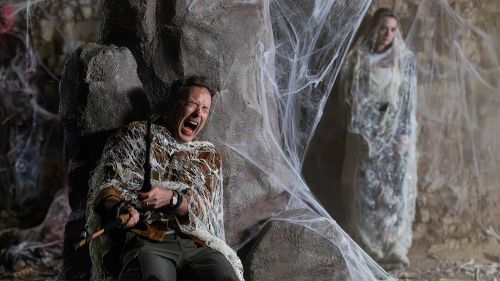
Add the latest installment, Predator: Badlands, to the ever-growing list of more-than-watchable sequels, because this film not only delves deep into the Predator mythos, but, in the end, it takes the Predator and turns him into a real stand-up guy lonesome scion of alien revenge.

No, really.

The Predators — or, as they’re called now, the Yautja — are in this clan that a little guy named Dax is about to be initiated into. Challenged by his brutish father who, sadly, decapitates his older brother for being weak — Yikes! Are you sure that wasn’t my dad? — Dax crash-lands on the alien world of Ganna, where he’s going to become a man or, you know, die trying.

On the hostile planet — apparently, it’s a real hellscape — he immediately finds vine-like strangling creatures, exploding caterpillars and large plants that shoot out poisonous spikes and immediately paralyze the body. And that’s in the first 15 minutes.

Eventually, he finds an android survivor (Elle Fanning) from a Weyland-Yutani (shades of Alien’s Xenomorphs?) scouting party. Along with a cute rolling-ball creature they call Bud, they try to find the mythical Kalisk that Dax wants to kill to impress his father.

While that’s going on, the android’s identical twin sister and a bunch of space marines find Dax’s ship. They take all the weapons and, of course, want to capture and eviscerate him. They all engage, entangle and enrage with a round of alien psychoanalysis about grief and loss, as well as old-fashioned shoulder cannons and wrist-controlled atom bombs.

With sparse alien dialogue and the mannerisms of a hardened warrior, New Zealand actor Dimitrius Schuster-Koloamatangi is more than serviceable as Dax, alternating between immature warrior to seasoned champion for whom, as the mid-credits scene teases, more adventures will come.

But if anything needs more credit, it is Dan Trachtenberg, directing his third entry in the franchise. Between Prey and the animated Predator: Killer of Killers, he is on a creative streak I am actually down with, giving Dax and all the Yautja actual characteristics that make than more than, well, Predators.

In the end, Predator: Badlands is just a wildly entertaining entry in a nine-movie series that is only picking up camouflaged steam, and I am here for it. —Louis Fowler

Get it at Amazon.

Censor Addiction (2026)

In 2030, the hubbub in America isn’t around the morning-after pill, but the good-morning pill. The drug was developed to cure violent tendencies until its CEO, Addis (Chris Moss), realized the greater windfall stood in having it secretly cause such urges, thus increasing demand. Bwah-hah-hah!

Meanwhile, a former employee named Soul (Daniel O’Reilly) leads a small movement of highly armed revolutionaries against Addis’ greedy, grubby ways. Soul, who looks like John Travolta playing a Ken doll (or vice versa), is so committed to the movement, he initially refuses sex with his hot-to-trot wife (Marnette Patterson) so he can focus.

Like me, Censor Addiction sags in the middle, as each stage of the factions’ ongoing tête-à-tête grows protracted with heavy dialogue. Human action figure Mike O’Hearn (National Lampoon’s TV: The Movie) livens things up for a minute as an Addis fixer who feels no pain, has advanced healing properties and could be the result of entering “bicep but a person” into ChatGPT. Former pin-up model September D’Angelo also livens things up by falling to the ground rather delicately for someone violently plugged with machine-gun fire.

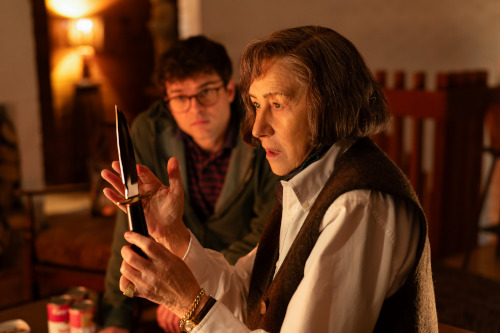
Censor Addiction is basically a reunion of Michael Matteo Rossi’s The Charisma Killers from 2024, right down to the appearances of Vanessa Angel, Vernon Wells, Ana Ciubara, what looks like the same living room, a familiar driveway, and wacko character names — here including Wizard, Pillar and Canvas Jones. The latter is an Addis henchman played by Bart Voitila (David DeCoteau’s The Pit and the Pendulum); he and Moss stand out by acting with the proper sodium level for the ham they’re given. That’s in step with the Addis commercials that open the movie, targeting Big Pharma with satire reaching for RoboCop-style heights. Rossi doesn’t get there, but he should try more of that. —Rod Lott

Get it at Amazon.

Pee-wee’s Big Adventure (1985)

As the slightly sweet, slightly menacing bed of “chugga-chugga” piano music wildly encapsulates Tim Burton’s feature debut, you know something magical is going to take place from the first minute — no, scratch that — the first second of Pee-wee’s Big Adventure.

Usually, when I review movies, they’re either new (or newish) or something I haven’t seen in eons and want to revisit. But in this case, I’ve watched Big Adventure an average of two or three times a year for the past 40. Safe to say, it attached itself to and in me. I still love this film and, even more, I want the generations after mine to enjoy this film. It’s a fantastic, wondrous and completely absurdist joyride on the vintage handlebars of Pee-wee’s treasured bicycle.

That bike starts the plot rolling, as one day, Pee-wee’s bike is stolen outside a shopping center. Everyone is a comical suspect until a fake psychic tells him his bike is currently in the basement of the Alamo in Texas. With this information, Pee-wee (Paul Reubens) sets out on a road trip with hardened criminals, lovelorn waitresses, a ghosty trucker and, of course, the Satan’s Helpers motorcycle gang. When he eventually finds his bike, Big Adventure becomes a madcap chase through a movie studio with Godzilla, Twister Sister’s Dee Snider and two handfuls of snakes.

I’d say it all makes sense, but you’ve seen this before, right? Instead, I implore all you well-read, mostly subversive, somewhat alternative culturists who grew up on Pee-wee Herman to dust off that VHS tape, bargain buy DVD or the gorgeous Criterion Blu-ray, and share it with the next generation of smart alecks, obnoxiously conceited and, really, the only people I want to be around in the future.

With its kitschy color scheme and surreal set design, Pee-wee’s Big Adventure is a true love letter to all the weird kids, informing them of their life options as they go out into the world and make their own art, hopefully with an oddball bike and original persona to match. —Louis Fowler

Get it at Amazon.

Corey Feldman vs. the World (2025)

No doubt as a child of Hollywood, Corey Feldman has seen some shit and experienced no shortage of shit. But for someone who professes a desire to rise above that shit, Feldman sure can’t help himself from stirring it.

Marcie Hume’s fascinating all-access documentary, Corey Feldman vs. the World, shows her (in)famous subject as a bundle of contradictions, the least of which is being in his mid-50s yet still dressed for a Tiger Beat shoot. He believes people are out to scam him, yet guests at his third wedding are asked to pitch in $40 apiece for the food. He accuses others of riding his coattails, yet opens his concerts with a hype video listing every A-list musician he’s seemingly ever shared a room with. The same video prominently features clips of frequent co-star Corey Haim, an awkward nightly spotlight to grant one’s sexual abuser, as Feldman claims the late Haim was.

Perhaps Feldman’s most incongruous element on display is that despite his undeniable skill and likability as an actor (see 2004’s The Birthday for proof from this millennium), the doc finds the erstwhile Goonie pursuing rock-musician stardom. To garner attention, he’s backed by an all-female band in cheap costumes that Spirit Halloween might market as “Sexy Angel.” Like Hugh Hefner minus the mansion, Feldman lets the ladies live with him, his wife and “their” girlfriend, a scenario he presents to interviewers as so noble, you’d think he was appealing to the United Nations. Never mind some of Corey’s Angels have zero experience playing an instrument before embarking on a 10-city tour, because he’s just helping malleable young women achieve their dreams — well, provided they meet his standards of beauty.

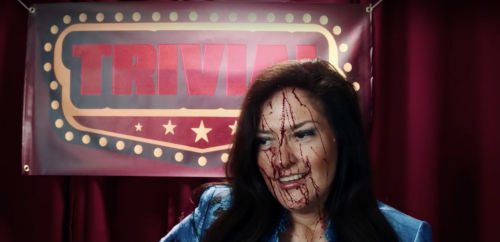
As anyone who’s witnessed Feldman trot out his Michael Jackson simulacrum act since his Dream a Little Dream era knows, singing is not among his talents. However, manipulation and narcissism appear to come to him naturally. I’m not saying Hume’s fly-on-wall camera captures Feldman running a cult in between sad concerts, but he certainly exhibits cult-like behaviors, from comparing himself to the Messiah to seeing everything as a conspiracy against him (hence, the movie’s title). The tour bus breaks down; it has to be the bus company trying to make more money. His show gets a bad review; the journalist must belong to “the dark media.” If that weren’t enough, his home is a shrine to himself, right down to the vinyl Barnes & Noble book signing banner.

Corey Feldman vs. the World gives the man every opportunity to set the record straight and rehabilitate his parasitic image. Like everything else he’s been given or earned over the years, he squanders that potential. It’s a shame, because you want to see him succeed. In his explanations (or attempts at such) for transgressions, one recognizes the bullshit-laden patter of someone so high on their own supply, they’re unable to atone, but have deflection down pat. Feldman is his own worst enemy; having cried wolf so many times in the past — several within these engrossing 98 minutes, and its public coda especially — he continues to deplete any built-up reserve of credibility. As a result, he’s the most unreliable narrator of his life — one he sees as an epic poem, if not a revered classic of world literature. Why don’t you recognize his genius? —Rod Lott

Thrashin’ (1986)

The 1980s had their “big” movies dedicated to the dawn of the most extreme of sports, little-seen mainstream product like Rad, North Shore, Body Slam or even The Dirt Bike Kid with Peter Billingsley and half the cast of HBO’s Not Necessarily the News.

But only one movie made me want to skateboard down a “freewheeling boogieman” on the 405, bounce off a “parallel shortbus” at the youth center and bust out with a “360 knapsack” on a “total doogie” — that’s the lingo, right? — and that movie was Thrashin’.

The whole skating craze was more my younger brother’s bag. I’d watch him and his friends doing “ollie-hopnoodles” and “jitterbuggin’ the manatee” in the neighborhood park while I sat in the shade of a tree and read my dystopian fiction novels above my reading level — a sad childhood, to be sure.

In that summer of 1986, though, Thrashin’ was advertised on the back of every Marvel comic book and, man, I was as pumped as a fat kid with no athletic ability could be pumped: I needed to see that movie!

Too bad there were no theaters in my small town. The next year, I rented it on VHS and thought it was okay, but my skating fandom already had died; by then I was obsessed with extreme bike-messengering, mostly because of Kevin Bacon’s Quicksilver.

Since that long-lost rental, I hadn’t revisited Thrashin’ until yesterday. A dated piece of analog flotsam, it’s from a more innocent time when all you needed to be a hero was your absolute will to be the best skater in the Valley.  

Corey (a baby-faced Josh Brolin) is the new kid in town and he’s got that will. Decked out in his loose Vision tee, stylin’ Jams shorts and parent-approved elbow and knee pads, he cruises in the wind toward PG-13 oblivion while a generic “punk” song by Meat Loaf, with lyrics about “achieving your dreams” and “flying high,” plays on the epic soundtrack,

With plenty of sick “flip-kicks,” “Mr. Coffees” and “Gorgonzola dunks,” Corey and his friends call themselves the “Ramp Locals” because, well, they made a ramp. Eventually, they run into the skater punks from the other part of town, led by swarthy Tommy (’80s mainstay Robert Rusler).

While the Red Hot Chili Peppers play a skate party — the band’s second movie of the year, alongside Tough Guys with Kirk Douglas and Burt Lancaster — the Romeo and Juliet vibes take precedence as Corey and Tommy’s sister, Chrissy (Pamela Gidley), spend time playing games at an outdoor carnival, as you do.

Even though the stakes are low, the punks are pretty mad and make a wager to control the whole skateboarding scene, as well as, um, a corporate sponsorship. As you can guess, after a rehabilitation montage, Corey soundly defeats them and you think the punks will be mad … but, instead, Tuff Tommy shakes Corey’s hand and says, “Good game, brah!” or something to that effect.

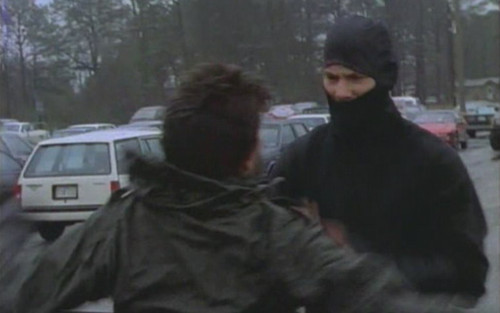
Aided by a bunch of ’80s skaters like Tony Hawk and Tony Alva, both Brolin and, to smaller effect, Rusler are pretty good in their melodramatic roles. But the real star is director David Winters, a longtime choreographer whose work on Linda Lovelace for President, Roller Boogie and the Star Wars Holiday Special make me think his life story would be a great movie.

In the end, Thrashin’ was a near-wipeout of the whole skateboard craze, schooling me on the fads and foibles that, as a young person in the ’80s, I could often find myself in. At least not until Gleaming the Cube … right, brah? —Louis Fowler

Get it at Amazon.

Random Genre & Cult Movie Reviews